

On August 10, 2024, Beijing HEYI Green Foundation and the Beijing Ginkgo Foundation jointly released the China Multi-Issue NPOs Climate Action Baseline Assessment (2024) in Beijing.
This survey report presents baseline findings from a comprehensive assessment of Chinese non-profit organizations (NPOs) across diverse issues, evaluating their awareness of climate change, operational linkages to climate issues, action strategies, funding, and capacity-building needs. The findings offer critical reference data for stakeholders seeking to support climate initiatives in China's nonprofit sector.
The survey employed mixed research methods, combining questionnaires (148 NPO samples) and in-depth interviews (30 NPO directors).
Between January and May 2024, the Beijing He Yi Green Foundation, Beijing Ginkgo Foundation, and partner organizations distributed questionnaires via their WeChat official accounts, official websites, email, and targeted invitations to representative Chinese nonprofits. Of the 151 responses received, 148 were validated (98% validity rate).
The 148 participating organizations represent 28 provincial regions across China. 67% (n=99) of the respondents' core operations are based in county-level areas. These organizations span 14 public issues, such as environmental protection and animal welfare, urban community empowerment, rural revitalization, marginalized group support, educational equity and holistic development, ESG, disaster prevention and reduction, nonprofit capacity building, etc.
I. Climate Change as a Perspective
Historical review reveals that climate change has long been recognized within China's nonprofit sector, not as a novel issue or the exclusive domain of environmental NPOs, but as a transformative perspective.
As early as 2007, pioneering environmental NPOs, including Friends of Nature, WWF China, and the Institute of Public and Environmental Affairs (IPE), conducted a questionnaire survey among 200 Chinese NPOs working on environmental protection and sustainable development. They convened two thematic workshops with dozens of active NPOs, culminating in a series of seminal reports. By the 2009 UNFCCC COP15 in Copenhagen, Chinese grassroots organizations had begun articulating their climate advocacy on the global stage.
However, due to geopolitical tensions around climate governance and shifting domestic economic priorities, these efforts failed to promote sustained traction. Post-2010, apart from fragmented pilot efforts, China's non-profit organizations largely entered a climate "silent decade".
Yet the forward-thinking analyses in those early reports (particularly on climate justice, adaptation-mitigation synergies, and community-based climate solutions) remain remarkably prescient, offering reference value for current practices.
II. Key Findings
2.1 Strong consensus on climate change among respondents
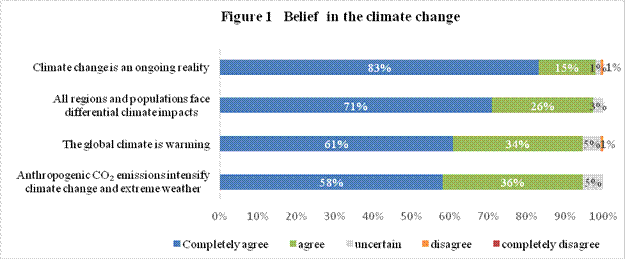
Among the surveyed organizations, despite working across diverse areas, there was overwhelming agreement on the reality and urgency of climate change.
Survey data reveals that 98% of the respondents acknowledge "climate change is an ongoing reality"(83% completely agree and 15% agree), 97% affirm "all regions and populations will face climate impacts to varying degrees",95% agree "global warming is occurring",94% recognize "anthropogenic CO₂ emissions are intensifying climate change and extreme weather frequency/severity"(Figure 1).
2.2 Climate crisis as primary driver for action
The escalating climate crisis serves as the primary catalyst for NPOs' proactive climate initiatives.
80% of respondent organizations report direct exposure of their focus regions/populations to heightened frequency and intensity of extreme weather events—the most acutely perceived climate impact.
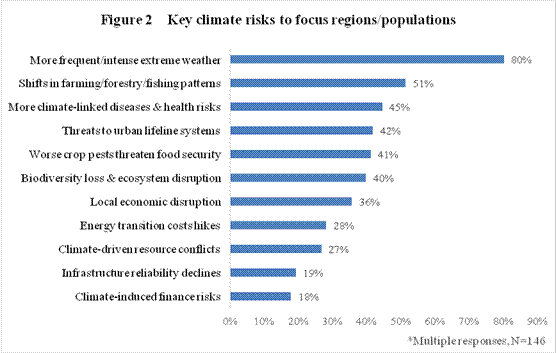
Beyond meteorological extreme disasters, climate-induced disruptions extend across farming/forestry/fishing patterns (51%), public health (45%), urban lifeline systems (42%), food insecurity (41%), and biodiversity loss (40%).
While secondary climate risks, including energy transition costs, climate-driven resource conflicts, infrastructure reliability and climate-induced finance risks, were cited less frequently, their recognition by specialized NPOs underscores the crisis's systemic nature (Figure 2).
This has spurred 74% of organizations to integrate climate considerations into their core programs (36% highly relevant, 38% moderately relevant). Grassroots groups, especially county-level actors, are already implementing water resource management, disaster risk reduction, and assistance for climate-vulnerable populations despite resource constraints.
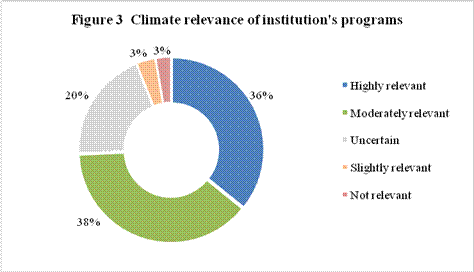
Besides, 20% of respondents were uncertain about the linkage between their organization's programs and climate change (Figure 3).
2.3 Diverse climate intervention fields
Non-profit organizations are leveraging their agility and localized presence to pioneer climate interventions in niche areas often overlooked by markets or governments.
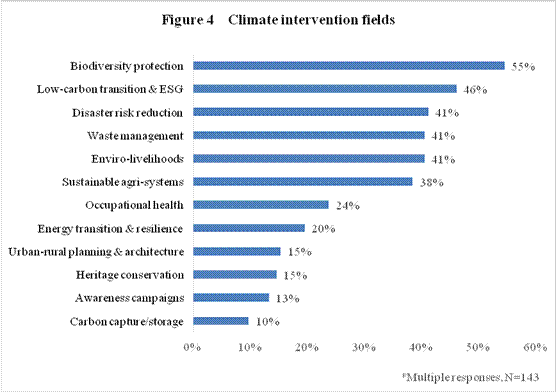
Survey data reveals that, beyond traditional field of environmental protection and rural development, such as biodiversity protection(55%), waste management(41%) and sustainable Agri-systems(38%), Chinese NPOs are now engaging in emerging climate-related fields such as low-carbon transition and ESG(46%), occupational health(24%), energy transition(20%), climate-smart urban/rural planning and architecture design(15%), cultural relics preservation(15%), and carbon capture and storage(10%). (Figure 4)
Notably, Rural areas, agricultural systems, and smallholder farmers exhibit significantly higher climate vulnerability compared to urban zones and other industries, and weak grassroots governance and rural depopulation trends compound their exposure to climate risks. China’s emergent grassroots disaster-response networks are addressing these gaps through decentralized collaboration, mitigating systemic vulnerabilities exacerbated by climate change.
2.4 Dual Focus: Mitigation & Adaptation
Climate action strategy
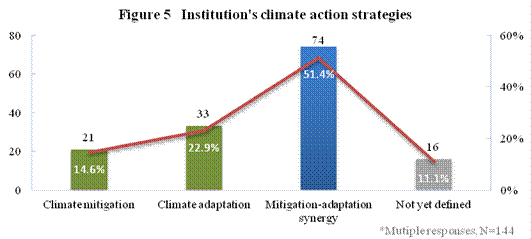
Survey data reveals that over 50% of respondent organizations adopt integrated climate mitigation and adaptation strategies, reflecting both global climate governance priorities and urgent local needs (Figure 5).
Primary intervention approaches
In terms of intervention approaches, over 60% of respondents adopt frontline practice and direct intervention, knowledge production and dissemination, or research-based policy advocacy as their primary methods.
The next common approaches are sector-wide capacity building (42%) and pilot research and technological innovation (19%).
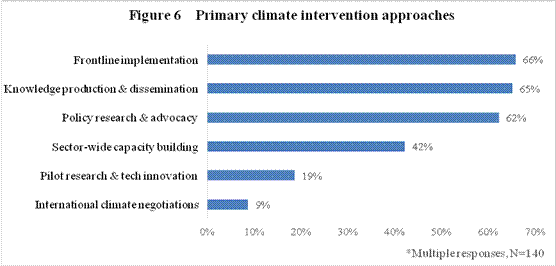
Notably, only a small fraction (9%) of organizations adopt international climate negotiations as their primary climate action pathway (Figure 6).
Currently, Chinese NPOs remain in a post-hibernation restart phase regarding climate engagement, with limited international participation. Mitigation efforts show slightly higher international engagement (led by environmental NPOs with global ties), while adaptation initiatives are predominantly hyper-local, focusing on rural/urban community resilience. Several place-based projects have gained international recognition as best practices.
In the future, as a cohort of leading nonprofit organizations across various issues adopts climate change perspectives, this signals an impending surge in nonprofit engagement in climate affairs.
2.5 Funding Challenges & Capacity-Building Needs
Due to the absence of a mature climate financing system, NPOs face significant constraints in fundraising channels and capacity.
In the past year (2023), only 8% of surveyed organizations secured over CNY 1 million (USD 138,000) in climate-specific funding, with 6% raising CNY 510,000–1 million (USD 70,500–138,000) and 7% obtaining CNY 310,000–500,000 (USD 42,800–69,000).
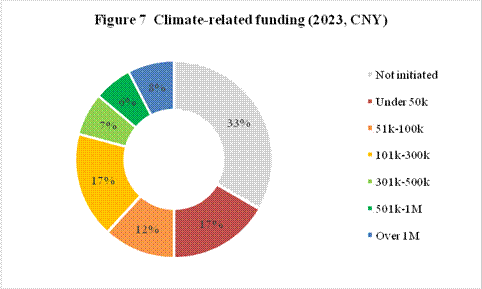
Forty-six percent of respondents received under CNY 300,000 (USD 41,500), comprising 17% below CNY 50,000, 12% at CNY 51,000–100,000, and 17% at CNY 101,000–300,000, while one-third (33%) had not initiated dedicated climate fundraising (Figure 7). Many organizations rely on self-funding or voluntary contributions to sustain their climate actions.
Key Operational Challenges
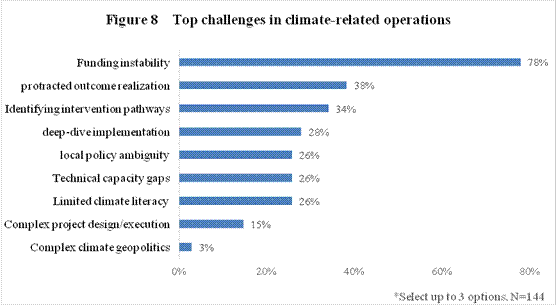
Therefore, funding instability was cited by 77.8% of respondents as the top challenge, reflecting systemic funding gaps.
Other operational barriers were reported less frequently, primarily because most organizations remain in the nascent stages of climate engagement with underdeveloped program frameworks.
For mature implementers, however, key challenges involve protracted outcome realization (38%) and deep-dive implementation challenges (28%). (Figure 8)
Key capacity-building needs
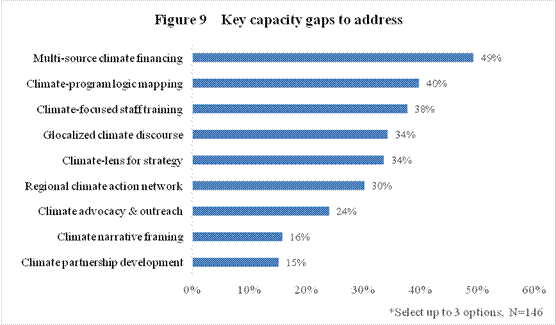
Nearly half (49%) of respondents cited multi-source climate financing as their most urgent need, requiring expanded funding streams and stable support mechanisms.
Secondary priorities fall into three categories: (1) Program/strategy alignment with climate issue, evidenced by demands for climate-program logic mapping (40%), climate-focused staff training (38%), and climate-lens for institutional strategy(34%); (2) Bridging international climate discourse with local implementation, combining glocalized climate discourse (34%) with climate narrative reframing (16%); (3) Partnership ecosystems, encompassing regional climate action networks (30%) and climate partnerships with domestic/global climate organizations (15%). (Figure 9)
Regarding funding and support modalities for climate action, NPOs overwhelmingly prefer sustained micro-grants (75%)—a model proven effective for sustaining grassroots initiatives. The second-most desired format is thematic co-funding for joint action programs (62%), which could enhance collective impact while mitigating individual organizational risks.
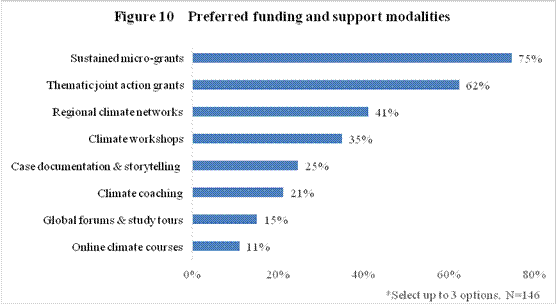
Other frequently cited support formats include regional climate networks (41%), climate workshops (35%), case documentation & storytelling (25%), and tailored climate coaching (21%). A minority of organizations expressed a need for global forums & study tours (15%). (Figure 10)
III. Conclusions & Recommendations
3.1 NPOs' Unique Value: Low-Cost Exploration and Public Engagement
The climate crisis stems fundamentally from infinite capital accumulation and the relentless expansion of production and consumption patterns. Addressing the climate crisis requires systemic lifestyle changes beyond techno-financial solutions.
As grassroots actors, non-profit organizations should leverage their strength in social capital integration to promote low-cost, accessible, and scalable climate actions through community-based practices and policy advocacy, ultimately bringing climate solutions into the daily lives of ordinary people.
3.2 Building Climate Literacy and Risk Assessment Competencies
With climate impacts manifesting as immediate threats rather than distant risks, NPOs should enhance essential climate competencies.
At the cognitive level, NPOs should strengthen foundational knowledge through IPCC assessment reports and other scientific resources to develop a macro-level perspective.
At the operational dimension, NPO practitioners must master practical climate risk assessment methodologies, including community-level vulnerability mapping and disaster preparedness planning, which are the bedrock of effective frontline interventions.
3.3 Contextualized Program Design
Effective climate project design requires "big Vision, local solutions”, aligning climate perspective with institutional missions and local climate vulnerabilities to identify entry points, and avoiding templated or fragmented approaches.
While national climate policies and international best practices inform planning, community-based adaptation remains paramount. NPOs should establish evidence-based linkages between climate change and existing program areas to design localized, adaptive practice plans.
3.4 Foundations' Role: continuous grants and capacity-building mechanisms
Grassroots non-profit organizations, including a vast number of volunteer groups and community-based organizations, represent the primary growth area for future climate actors due to their agility, rapid iteration capacity, and hyper-local focus. However, their climate literacy and implementation capacity vary significantly, creating an urgent need for structured capacity-building support.
Grantmaking foundations and intermediary institutions should provide sustained micro-grants and facilitate regional or thematic climate learning networks. Such initiatives enable grassroots actors to identify climate linkages within their existing programs, develop feasible solutions, and ultimately contribute to building regional climate resilience.
3.5 Multi-Stakeholder Regional Coordination Mechanisms
The survey report recommends that government agencies and leading foundations intentionally mainstream climate considerations into their respective priority areas. This involves supporting grassroots NPOs in piloting climate practice while simultaneously clarifying their own strategic positioning.
Given the place-based nature of climate impacts, regional coordinated action networks should be established to align local government climate plans with multi-stakeholder (public-private-NPO) initiatives. These collaborative structures are vital for reinforcing regional disaster risk reduction frameworks and building comprehensive climate adaptation systems.
Research team:Li Dajun,Yan Yuxiao,Wu Haoliang
Writer:Li Dajun
Address: Room 1606, Building 2, Bixingyuan Residential Compound, No. 36 Zhichun Road, Haidian District, Beijing



Support the small green forces to grow